Picture the meeting. The quarterly numbers are up on the screen, and the organic traffic line is pointing in the wrong direction. The CMO asks the obvious question, why is this happening, and the room goes quiet, because the honest answer is that nobody is entirely sure. The content calendar was full. The agency hit its deliverables. The keywords still rank where they always ranked. And yet fewer people are arriving at the site than a year ago, and the trend is not slowing down.
If this sounds familiar, you are not looking at a content problem or an agency problem. You are looking at a structural change in how search works, one that accelerated sharply in the last few weeks, and one that most marketing teams have not yet absorbed into how they measure success. The traffic is not lost because someone made a mistake. It is moving because the ground underneath search shifted, and the dashboards most teams still use were built for a version of the internet that is quietly ending.
What actually changed in May
On May 19, 2026, at its annual I/O conference, Google announced the most significant change to Search in more than 25 years: the search bar is being rebuilt around Gemini, and AI Mode, the conversational answer-first experience the company launched in 2025, has become the default rather than an optional tab. In practical terms, this means that when someone searches for a question your business could answer, Google increasingly answers it directly, on its own page, by synthesizing information from multiple sources into a single response. The ten blue links you spent years trying to climb are now frequently sitting below an AI-generated summary that resolves the query before anyone scrolls.
This is not a far-off prediction. It is measurable today. Google’s own May 2026 guidance to website owners confirms that there is no separate “AI search” discipline to hire for. Strong technical SEO foundations plus genuinely original content remain the basis for visibility across every AI surface. The mechanics changed, the fundamentals did not. But the consequence for traffic is real, and the numbers are worth sitting with.
The numbers your dashboard is not showing you
The most rigorous measurement of this shift comes from SparkToro and its data partner Datos, whose clickstream study found that 58.5% of U.S. Google searches end without a single click to any external website. More than half the time, a person searches, reads the answer, and leaves. That figure predates the latest AI Mode rollout, which means the real number today is almost certainly higher, and it climbs dramatically on queries where an AI summary appears, with several industry analyses placing the zero-click rate above 80% on those searches.
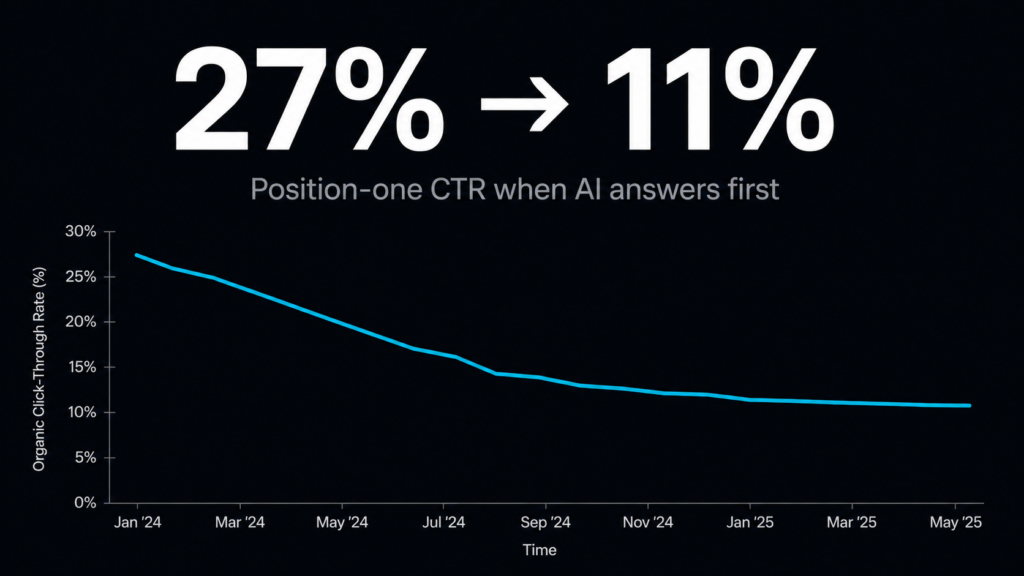
The click-through collapse on the queries that do still happen is just as stark. SISTRIX data from early 2026, measured in the German market, found that the click-through rate for the number-one organic result drops from 27% on a normal query to as low as 11% when an AI Overview sits above it, a decline of roughly 60%. Independent research from Seer Interactive, covering millions of impressions across dozens of brands, found a comparable 61% drop in organic click-through rate on queries where an AI Overview is present. Whichever study you trust, the direction is identical: ranking first no longer means what it meant two years ago.
Here is the part that matters most, and the part almost nobody is acting on. Being cited inside an AI Overview is now more valuable than ranking below it. Multiple studies, including SparkToro’s own State of Search work, found that brands cited inside an AI summary receive roughly 35% more organic clicks than they would from a traditional first-place result, and the visitors who do click through convert at several times the rate of ordinary organic traffic, because they arrive already informed and high in intent. The traffic did not simply disappear. It concentrated. It went to the brands the AI chose to name, and away from everyone else.
Why this is a measurement problem before it is a content problem
The reason the meeting goes quiet is that the tools most teams rely on were built to measure clicks and rankings, and clicks and rankings are no longer the whole story. A page can be ranking exactly where it always did, generating more impressions than ever, and still bleed traffic, because the impression now resolves on Google’s page instead of yours. If you only watch rankings, the dashboard looks fine while the business quietly loses ground. The first practical step for any team seeing this pattern is to open Google Search Console and compare impressions against clicks over the last eighteen months. If impressions are flat or rising while clicks fall, you are watching AI features absorb the traffic that used to reach your site.
But there is a second blind spot that is harder to see, because no standard analytics tool measures it at all: whether the AI systems your customers actually use, ChatGPT, Gemini, Claude, Perplexity, and Google’s own AI Mode, are mentioning your brand when someone asks about a solution like yours. Your buyers are increasingly shortlisting vendors inside these tools before they ever visit a website or talk to a salesperson. If your brand is not in that synthesized answer, the opportunity never reaches your pipeline, and you will never see it in your analytics because the visit that would have shown up simply never happened.
What a CMO should actually do about this
The reflexive response to all of this is panic, usually sold by someone offering to rebuild your entire strategy around a new acronym. That is the wrong move, and Google’s own guidance says as much. The right move is more grounded, and it starts with knowing where you stand rather than guessing. There are three things worth doing before your next planning cycle.
First, fix your revenue-linked pages before anything else: your comparison pages, pricing pages, use-case pages, and category content. These are the pages where being cited by an AI translates most directly into pipeline, and they are usually the most neglected. Make the answers on them clear, short, factually dense, and backed by trust signals an AI system can recognize.
Second, audit the technical health of your site honestly. If your pages load slowly, render badly on mobile, or are hard for crawlers to parse, neither Google’s traditional index nor its AI layer will treat you as a reliable source to cite. A site that is technically broken cannot be cited no matter how good the writing is, and most teams have no idea their site is broken because no one has measured it recently.
Third, and this is the step almost no one is taking, measure how the AI engines see your brand right now. Not how you hope they see it. How they actually do. Find out whether ChatGPT and Gemini mention you when a buyer asks about your category, find out where your competitors are appearing and you are not, and treat that gap as a data point to work on rather than a mystery to worry about.
The brands that win this are the ones that measure it
The uncomfortable truth underneath all of these numbers is that most companies are flying blind. Only a small fraction of brands currently track whether they appear in AI-generated answers, which means the field is wide open for the ones who do. This is not a moment that rewards louder marketing or a bigger content budget. It rewards knowing exactly where you stand and acting on it before your competitors notice the shift.
That is the entire reason Skid Platform exists. It audits the technical health of your site in about two minutes, the same diagnosis that used to take a consultant most of a working day, and its AI Studio shows you precisely how often ChatGPT, Gemini, Claude, and Perplexity mention your brand today, where your competitors are winning the answers you should be winning, and what it takes to close the gap. No opinions, no panic, no rebuilt strategy you do not need. Just the data your dashboard has not been showing you.
If your traffic is falling and nobody can explain why, you do not need another meeting. You need to see how the AI sees you. You can run that check for free, right now, at www.skidplatform.com, before your next results review, not after it.
Sources
- Google I/O 2026 announcement and May 2026 website-owner guidance (Launchcodex analysis, May 2026)
- SparkToro & Datos, Zero-Click Search Study (58.5% U.S. zero-click rate)
- SISTRIX, AI Overview CTR impact, early 2026 (DACH market: position-one CTR 27% to 11%)
- Seer Interactive, organic CTR study across 5.47M queries (61% CTR decline on AIO queries)
- SparkToro State of Search (brands cited in AI Overviews: +35% organic CTR)
Note: zero-click and CTR figures vary by study, methodology, and region. Figures here are attributed to their primary sources where identifiable. Verify against the original studies before reuse in paid or regulated contexts.