The Uncomfortable Truth About Most AI-Powered SEO Tools
Let’s be direct: many of the “AI-powered SEO tools” on the market today are the same thing with a different logo. They connect to an existing AI service like ChatGPT or Gemini, put a nice interface on top, and call it a product. In the industry, this is known as a “wrapper” — a tool that wraps around someone else’s technology without adding much of its own.
We know this because Skid Platform started the same way.
And for a while, it worked. The results were useful, the interface was clean, and clients got value from it. But behind the scenes, we had a problem: our entire product depended on someone else’s technology, someone else’s pricing, and someone else’s decisions. If they changed something tomorrow, our tool could break overnight.
That realization forced us to ask a harder question: Are we building a real product or just renting someone else’s?
What Changes When You Decide to Build Real Value
Moving beyond a wrapper isn’t a marketing story — it’s a decision that changes everything about how you build.
For Skid Platform, it meant redesigning the product from the inside out. Instead of just sending your data to an AI model and showing you what it says, we started building our own system of rules, scoring methods, and analysis frameworks. Think of it this way: before, the AI was the brain of our tool. Now, we’ve built our own brain, and AI is one of the inputs that feeds it.
The result is a platform that doesn’t just tell you what’s wrong with your website’s visibility — it tells you what to fix first and how to do it, based on what will actually make a difference for your business.
Two Layers, One System: How Skid Platform Actually Works
Most tools do one thing. They either check if your website is technically healthy or they look at how visible you are in AI-powered search. Skid Platform does both — and connects them so you get the full picture.
Layer 1: SEO Dashboard — Your Website’s Technical Health Check
Before worrying about showing up in AI search results, your website needs to work properly. This sounds basic, but it’s where most brands lose ground without realizing it.
Think of your website like a building. If the foundation has cracks, it doesn’t matter how good the interior design is — the structure is compromised. SEO works the same way: if your site has technical problems, even the best content won’t perform as well as it should.
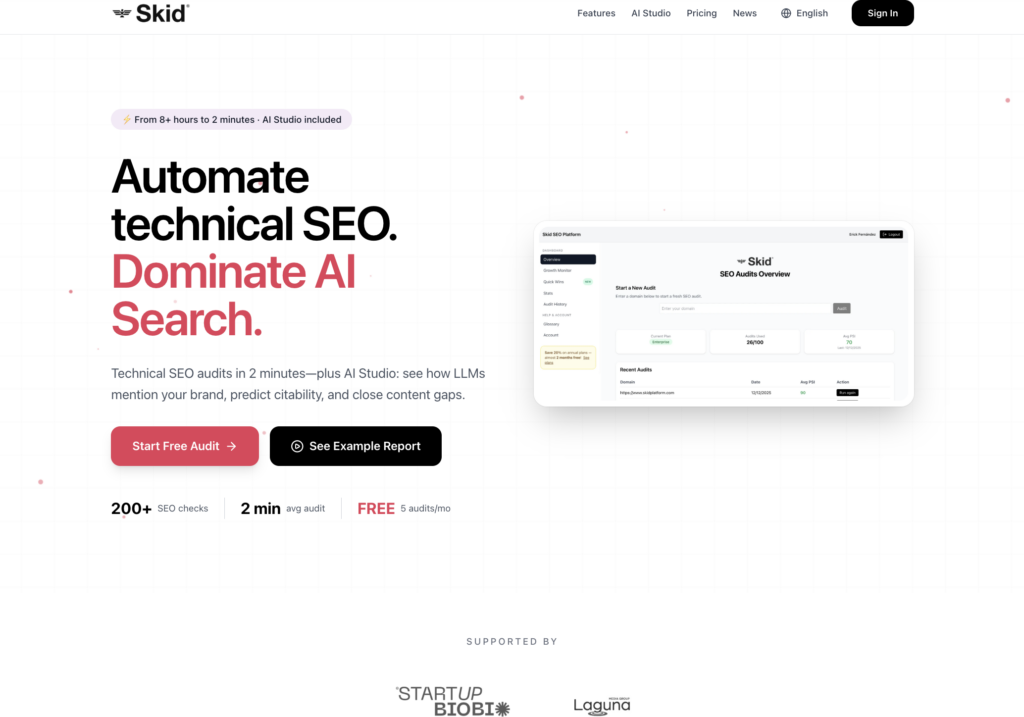
Skid Platform’s SEO Dashboard scans your website against 200+ technical factors in under 2 minutes. But here’s what makes it different from other audit tools: every issue is ranked by how much it actually affects your business, not by how complicated it is to fix.
For example, a missing page title and a broken redirect are both “errors.” But one might be costing you thousands in lost traffic while the other barely matters. Most tools treat them equally. We don’t.
What you get:
- 200+ automated checks on things that affect your search visibility — page speed, mobile experience, how your content is structured, whether search engines can properly read your site, and much more
- Business-impact ranking — instead of an overwhelming list of 200 issues, you get a clear priority order based on what matters most to your bottom line
- Plain-language action plans — every issue comes with specific steps to fix it, written so anyone on your team can understand what needs to happen, not just the developers
- Professional reports in one click — clean, client-ready PDF reports you can share with stakeholders or clients in seconds, with the option to add your own branding if you’re an agency
- Multi-site management — if you manage multiple websites (whether you’re an agency, a franchise, or a company with several brands), you can audit 30 to 100 sites per month from a single dashboard
This layer answers the “how” that most tools skip. It’s not enough to know something is broken. You need to know what to fix first and why it matters more than everything else on the list.
Layer 2: AI Studio — Preparing Your Brand for the Future of Search
Here’s the big shift happening in digital marketing right now: the way people find information is changing fundamentally.
For years, when someone searched on Google, they got a list of links. They clicked on one, visited a website, and found their answer there. That model is disappearing. Now, Google’s AI features, ChatGPT, Perplexity, and other AI assistants are generating direct answers — pulling information from across the web and presenting it without the user ever needing to click through to your site.